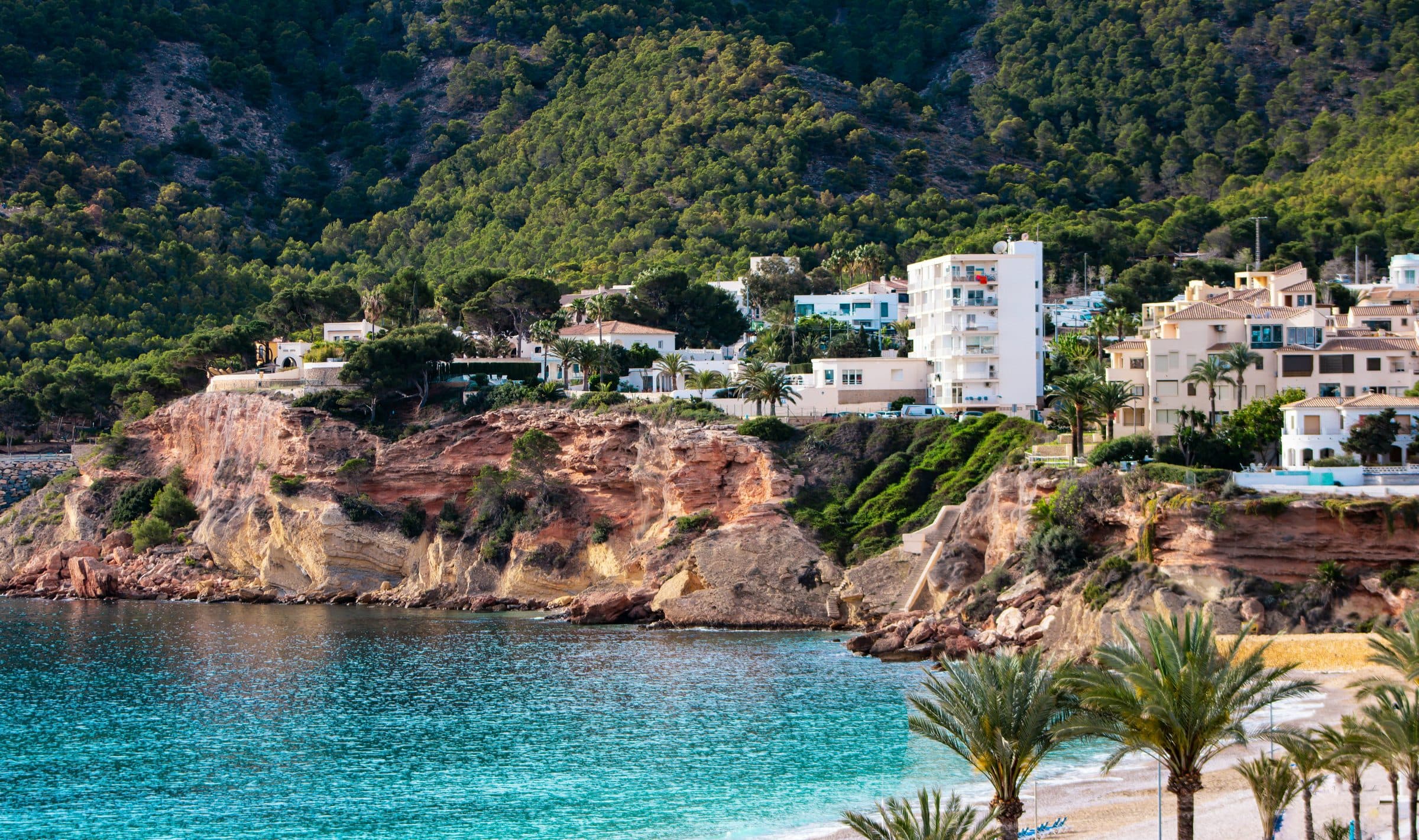
01Harbour town and seaside resort with year-round life, sandy beaches and pebble bays beneath the Montgó.
Budget ±€300k to €1M+, families, a firm favourite, year-round living.
Villas on the hillsides, apartments on the Arenal, village houses.
The green side of the Costa Blanca: sheltered bays, villages with character and an established international community. From Dénia to Altea. We guide you through every side of the purchase.

The landscape takes the lead here Where the south is flat and dry, here the coast folds itself around mountains and capes: the Montgó above Jávea, the Peñón de Ifach at Calpe, the Bèrnia behind it. That produces bays, cliffs and views you rarely find elsewhere along the Spanish coast.
Greener, with the same number of sunny days Around 400 to 500 millimetres of rain fall here per year, almost double the dry south, and you see it in the pine forests, vineyards and gardens that stay green all year round. The sun simply joins in: well over 300 sunny days.
An established international community International residents have lived here for decades, with their own associations, English-speaking care around Alfaz del Pi and international schools of repute. Your integration does not start from scratch.
Quality over quantity in the market This is the villa coast of the Costa Blanca, with Moraira as the most expensive municipality in the province. You pay more per square metre here than in the south, and in return you get location, build quality and lasting value.
Variety within a single region From the harbour and market town of Dénia to the artists' village of Altea, from fashionable Moraira to urban Benidorm, with wine valleys right behind the coast. Five different characters across some sixty kilometres.

The Costa Blanca North is not one place, it is five places. Between Dénia in the north and Altea in the south, character, price level and pace differ sharply. For most of our clients, one zone simply suits them better.
01Harbour town and seaside resort with year-round life, sandy beaches and pebble bays beneath the Montgó.
Budget ±€300k to €1M+, families, a firm favourite, year-round living.
Villas on the hillsides, apartments on the Arenal, village houses.
02Village-like and well-kept, a small marina, the most expensive square metres in the province.
Budget from ±€400k, seekers of peace and quality, privacy.
Villas with sea views, small-scale apartments by the harbour.
03Calpe more urban on the beach beneath the Peñón; Altea white, hilly and cultural.
Boulevard lovers and atmosphere seekers alike, a broad budget range.
Apartments with sea views, villas in Altea Hills, village homes.
04Urban by the sea with the best level of amenities on the coast, and the Northern European cluster of Albir and Alfaz.
Those who prioritise liveliness, care and accessibility; liveable even without a car.
Apartments with sea views, bungalows in Alfaz and La Nucía.
05Villages like Jalón, Parcent and Orba among vineyards and almond trees; more Spanish and quieter.
Peace seekers, more home and land for your money, full-time emigrants.
Fincas, village houses, villas with land.
Tell us what matters to you (peace, sea views, amenities, village life) and we will make an initial recommendation per zone.
The Costa Blanca North combines well over 300 sunny days with just enough rain to stay green: around 400 to 500 millimetres a year, mostly in short autumn showers. The monthly figures below are long-term averages for the coastal strip around Jávea and Dénia.
Averaged over the coastal strip; in winter you still get six hours of sun a day here.
Autumn brings short, sometimes heavy showers that keep the landscape green; between June and August it stays virtually dry.
The Montgó and the Bèrnia shelter the coastal towns from northerly wind and temper the extremes. Inland is a few degrees warmer in summer and has cooler winter nights.
Not the crowds of summer, not the showers of the autumn peak. You see the gardens in full green and the villages at their normal pace. August is too busy to view realistically.
Alicante airport (ALC) is 45 minutes from Benidorm and just over an hour from Jávea and Dénia. For the north of the region, Valencia airport (VLC) is the alternative, around an hour and a quarter from Dénia. Direct flights to both from Schiphol, Eindhoven, Rotterdam and Brussels.
From Northern Europe roughly 19 to 20 hours' drive via France and Barcelona. With one overnight stop it is comfortably done in two days. The AP-7 is toll-free in this region.
The AVE runs from both Alicante and Valencia to Madrid in a little over two hours, connecting to the European high-speed network.
The N-332 and AP-7 string the coastal towns together, and the TRAM connects Dénia via Calpe, Altea and Benidorm to Alicante: handy and scenic.
The northern Costa Blanca has one of the oldest international communities in Spain. Around Jávea and Moraira the international presence has been strong for decades, and the Albir and Alfaz del Pi zone is known for its Northern European cluster with the care to match.
International associations are the gathering point for residents and visitors in the region, with a full programme of activities.
It is not an expat bubble but a network: English-speaking care providers, clubs and entrepreneurs, alongside ordinary Spanish village life.

A strong, established group of residents, plus winter visitors and second-home owners.
GPs and specialists, concentrated around Alfaz del Pi, Albir and Jávea.
Including international associations, with activities for residents and winter visitors alike.
International associations and clubs.
For a coastal region of this size, the offering is remarkably strong. The Lady Elizabeth School (Cumbre del Sol, near Benitachell) is the region's British reference: from toddlers to A-Levels, with school bus routes along the whole coast. Xabia International College in Jávea offers the same British curriculum on a smaller scale.
Towards the south of the region are Elian's British School in La Nucía (British and bilingual, with the IB diploma) and Costa Blanca International College in Albir. The Spanish public system here is bilingual Spanish-Valencian; for young children a full route, for later arrivals something to weigh deliberately.
The choice depends on how long you are coming and what you want for your child. We are happy to help think through the school choice as part of the zone choice.
School fees range from €0 (public) to a higher amount per year (private international). We connect you to an education adviser when the choice becomes complex.
The Spanish healthcare system has two parts: the public SNS and a broad private offering. SNS is free for those with an EU pension or work rights, and of a European-level quality. Waiting times for non-urgent specialist care can be longer; that is why a large group of foreigners opt for a supplementary private policy.
The public Hospital Marina Salud in Dénia covers the north of the region, Hospital Marina Baixa in La Vila Joiosa the south. Private options include HCB Hospital Clínica Benidorm, with staff from across the EU, and IMED Levante in Benidorm.
For pension-age people with an EU state pension the S1 form applies: you keep your healthcare rights in Spain, and your home-country health insurance need not continue.
A broad picture to calibrate expectations. This is the highest price point on the Costa Blanca: Moraira is the most expensive municipality in the province of Alicante (averaging around €4.500 per m², idealista, February 2026) and the average asking price in Jávea is around €985.000 (idealista, Q1 2026). Within every range there are large differences; we give you a refined estimate per search profile.
Prices exclude ITP (9% in the Valencia region as of 1 June 2026; 11% above €1 million) or, for new-build, 10% VAT plus 1,4% AJD; plus notary and registration (together 1 to 2%).
Updated quarterly based on market data and our own transactions.
Off-market listings may fall below or above this range.

I'm originally from Amsterdam and now live in Benissa Costa. I love helping people make their dream of a home in Spain come true, across all budgets on the Costa Blanca. I know the region inside out, from daily life to the property market.
I often hear about quiet listings early through my network, before they officially come to market. Clients most often describe my guidance as friendly and helpful, because I genuinely listen and help you honestly with such a big decision.
Friendly, helpful and always honest.
The Costa Blanca North is a core area for us, but certainly not the only one. Four short side-by-side comparisons.
Green and hilly, sheltered bays, the highest quality level on the Costa Blanca.
Flatter, sunnier and noticeably more affordable, with the strongest international presence in Spain.
Urban and Mediterranean, the quintessential lifestyle city.
Mediterranean, premium to affordable, a strong international community.
The questions we get most about living on the Costa Blanca North. Missing something? Ask your question directly to our regional expert.
Start with accessibility: can the region be reached in a single day by car, and how many flights are there in winter? Then look at the climate and the character of the surroundings, because a rural village, a lively city and a holiday resort feel completely different. Also decide how much time you want to spend there and with whom: if you are emigrating with children, schools weigh in; if you are wintering as a retiree, climate and English-speaking care count more heavily. We think this through with you based on your situation.
An hour with our regional expert gives you more concrete information than ten hours of Google. You hear what fits, what does not fit, and which zone suits your situation.