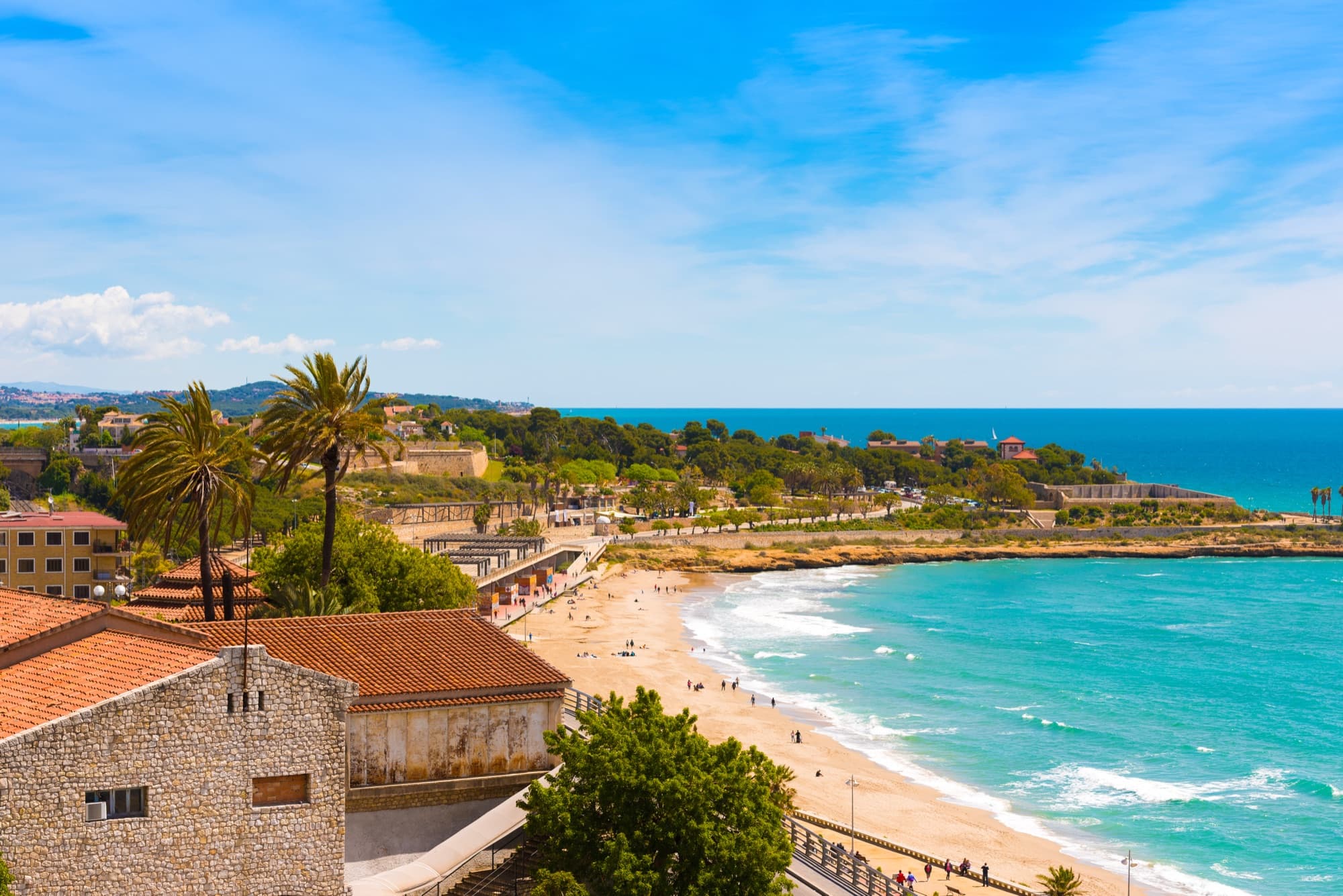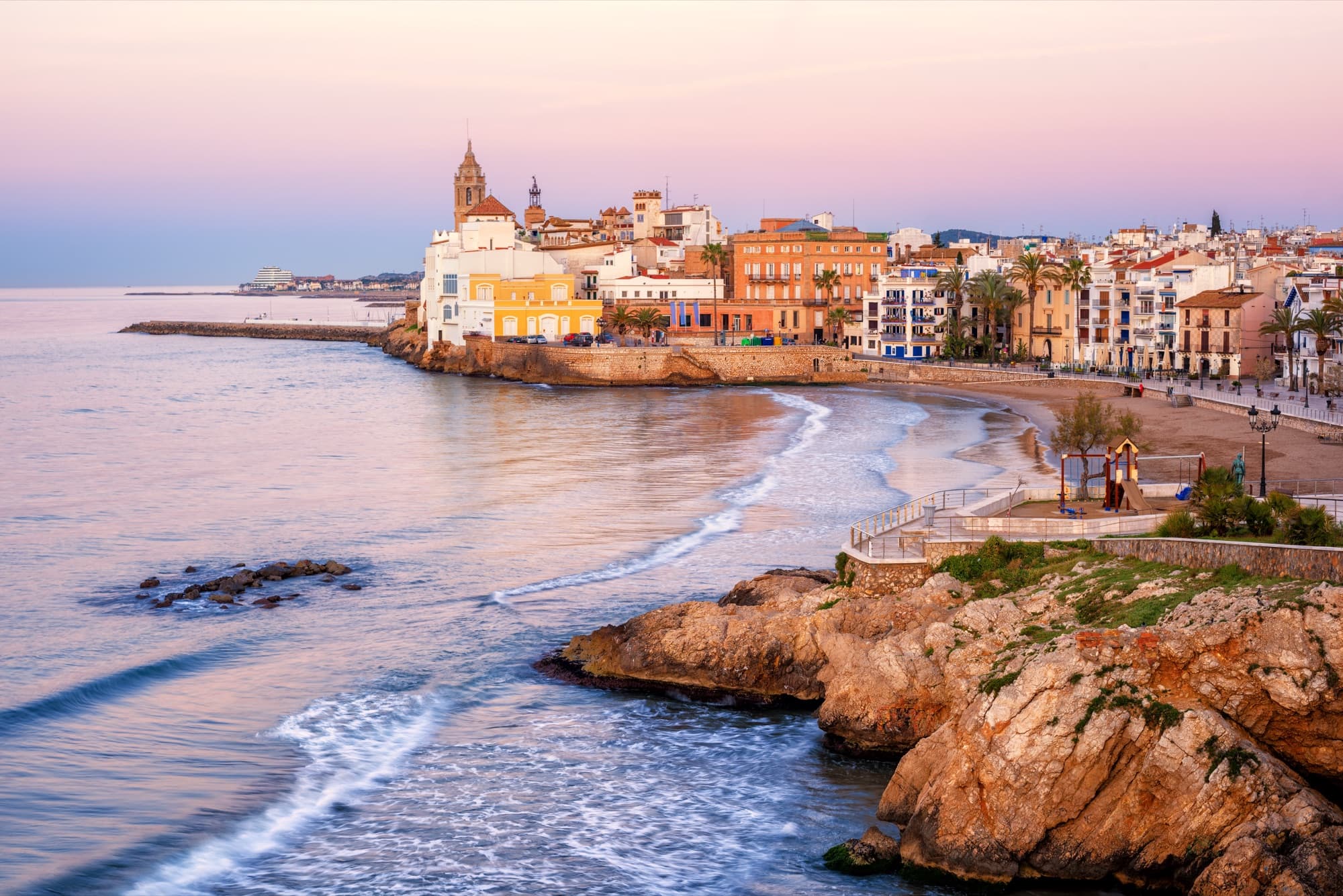
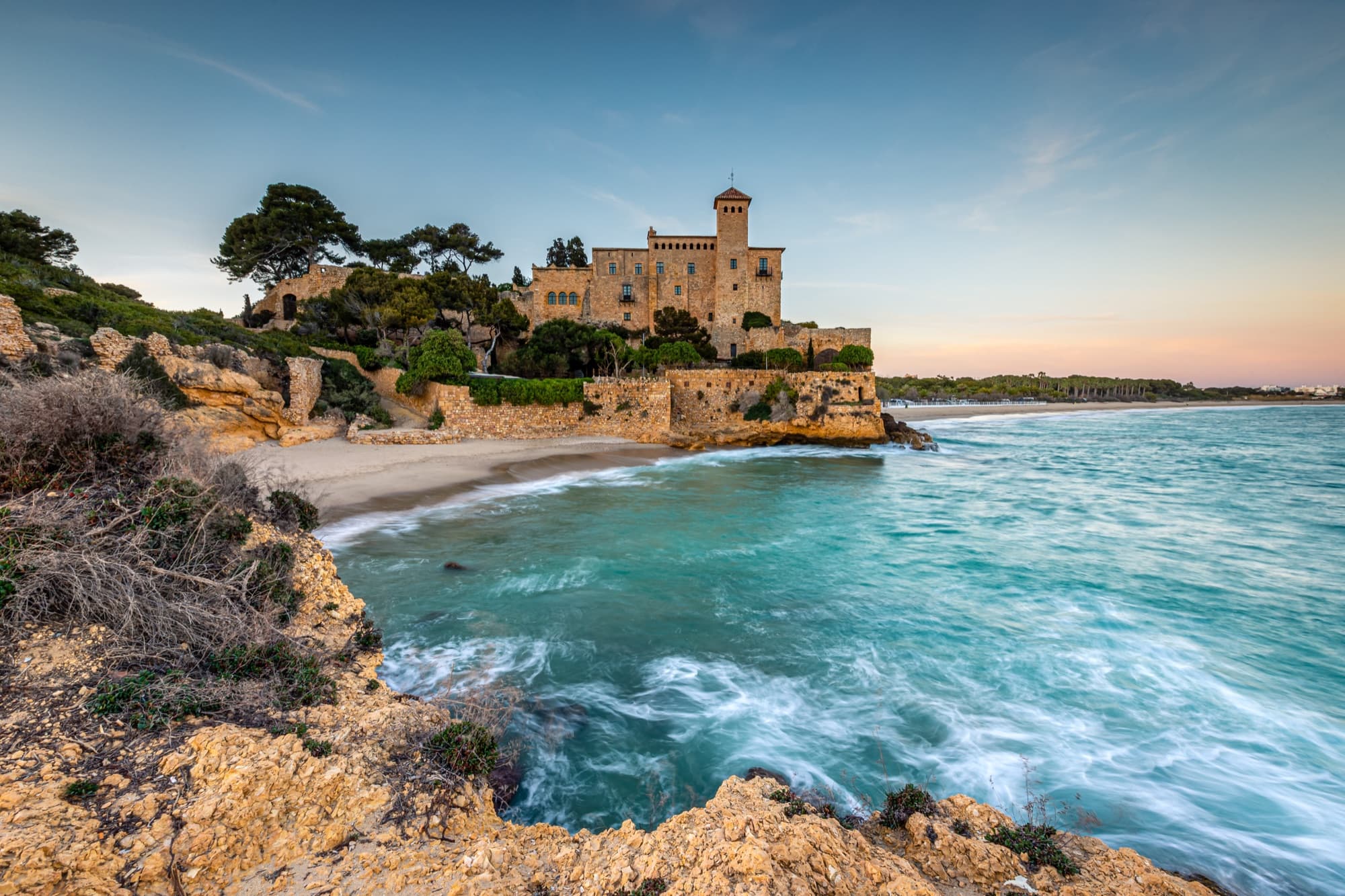
01Family resorts with long beaches, closest to Barcelona. Many Catalan second homes.
Those who want to keep Barcelona within the hour, those looking for a first second home.
Apartments on the promenade, terraced houses, homes in residential areas.
The golden coast of Catalonia: kilometres of shallow sandy beach, Roman Tarragona as its capital and the Ebro Delta as its wild finale. Almost as close as the Costa Brava, clearly lower priced. Independent buyer guidance since 2005, at every step.

This is the sand coast of Catalonia Where the Costa Brava is rugged and rocky, the Dorada runs flat and golden into the sea: wide beaches, shallow water and promenades you cycle along for kilometres. With children or grandchildren, this is the logical half of Catalonia.
Tarragona gives the coast a capital The Roman heritage of Tarraco, with the amphitheatre right by the sea, is on the World Heritage list. Around it lies a real working city that runs all year round. Few beach coasts have such a cultural anchor.
You simply drive there From much of north-west Europe it is one long day or two easy stages. The AVE station Camp de Tarragona ties the region to the high-speed network, Barcelona is an hour away and Reus airport sits right in the middle.
You buy at sharper prices here than on the Brava Salou and Cambrils list at around €2.600 to €2.800 per m², clearly below the level of the northern neighbour, while sun, sea and accessibility are every bit its equal.
Five different atmospheres along one stretch From lively Salou and gastronomic Cambrils to village-like Altafulla, from the quiet residential areas near Mont-roig to the fishing villages and flamingos of the Ebro Delta.

The Costa Dorada is not one place, it is five places. Between Calafell in the north and the Ebro Delta in the south, character, pace and price differ sharply. For most buyers, one zone clearly fits better than the rest.
01Family resorts with long beaches, closest to Barcelona. Many Catalan second homes.
Those who want to keep Barcelona within the hour, those looking for a first second home.
Apartments on the promenade, terraced houses, homes in residential areas.
02A World Heritage city alive all year round, with Altafulla as the village-like and most expensive gem of the province.
City people, culture lovers, those who want to live without a car.
City apartments, historic buildings, village houses in Altafulla.
Salou is lively with PortAventura next door. Cambrils is calmer, with a harbour and starred restaurants.
Families, lovers of the good life who choose a harbour over a promenade.
Seafront apartments, terraced houses, villas in Vilafortuny.
Small coves between long beaches, spacious residential areas, noticeably quieter.
Peace seekers, price-conscious buyers, those who want space around the house.
Villas and bungalows in residential areas, seafront apartments.
05Fishing villages with real harbours, and the rice fields and flamingos of the delta behind them.
Nature lovers, cyclists, those seeking Spanish village life. The lowest prices on the coast.
Village houses, apartments by the harbour, villas on the bays.
Tell us what matters to you (lively or quiet, city or village, beach or nature) and you get an initial recommendation per zone.
The Costa Dorada has a mild Mediterranean climate: around 550 millimetres of rain per year, falling mainly in autumn, summers around 25 to 28 degrees and winters just a touch milder than on the Costa Brava. The figures below are long-term averages for the coastal strip around Tarragona and Salou.
June and July reach ten to a good eleven hours of sun a day. The beach season runs from May into October.
October is by far the wettest month, with short, heavy showers. July is almost dry.
The coast lies more sheltered than the Costa Brava and catches less north wind. Around the Ebro Delta the mestral, the north-westerly wind from the Ebro valley, can blow hard. We weigh wind exposure per property.
You see the beaches without the summer crowds and you immediately notice the difference between the towns that live all year and the summer resorts. Exactly what you want to know before you buy.
From Utrecht or Antwerp it is around 1.400 kilometres: one long day's drive, or two easy stages with an overnight stop near Lyon. Just as on the Costa Brava, owners here simply drive back and forth, car packed and dog in the back.
Barcelona (BCN) is 2 hours and 5 minutes from Schiphol and an hour's drive from Salou. Reus (REU) sits in the middle of the region: Transavia and Ryanair fly there in summer from Schiphol, Eindhoven, Rotterdam and Charleroi, TUI fly from Belgium.
The AVE station Camp de Tarragona links the region with Madrid in around 2.5 hours and with Barcelona in a good half hour. Via Barcelona you change onto the TGV to Paris.
The AP-7 (toll-free) and the N-340 string the coastal towns together. The terrain is flat, the promenades have continuous cycle paths, and Tarragona and Reus provide the city amenities.
The Costa Dorada is first and foremost a Catalan and Spanish family coast, and within it an established group of Northern Europeans values precisely that down-to-earth character: less staging for foreigners, more everyday life.
The Dutch association Nederlandse Vereniging Tarragona has connected Dutch speakers across the province since 2010, with activities and a network of members. Most Dutch and Belgian residents live around Cambrils, Salou and Miami Platja.
Distance works here as it does on the Costa Brava: owners come often and briefly, and so grow into local life faster than those who fly twice a year.

An established group of residents and second-home owners, centred on Cambrils, Salou and Miami Platja.
GPs and dentists on the coast speak English and often French or German. The hospitals of Tarragona and Reus work with interpreters.
For Dutch and Dutch-speaking residents across the whole province, with monthly activities.
Honesty first: the range of international schools is thinner here than on the other Costas. Around Tarragona and Reus the options are limited, and the international schools of Barcelona are an hour away.
Set against that is a strong local system. The Catalan public and grant-aided schools are solid, and for young children growing up here that is a fully fledged route. The school language is Catalan, with Spanish alongside.
If you specifically want a British or international curriculum, the school question here partly determines the choice of region. We would rather say that upfront than afterwards, and we think along about the options.
School fees range from €0 (public school) to over €15.000 per year at the international schools of Barcelona. If the choice becomes complex, we put you in touch with an education adviser.
Spain runs two healthcare systems side by side: the public system (SNS) and private clinics. The public system is free if you work in Spain or receive a state pension from an EU country, and the quality is good. For a specialist appointment you sometimes wait a little longer. That is why many foreigners take out a supplementary private policy.
The Joan XXIII university hospital in Tarragona is the public regional hospital, with Sant Joan de Reus as the second large centre and Sant Pau i Santa Tecla as the third hospital in Tarragona. Private clinics are found in Tarragona and Reus, and the top hospitals of Barcelona are an hour away.
Do you receive a state pension from an EU country? Then your healthcare rights travel with you to Spain via the S1 form, a statement issued by your home country's health service. You use it to register with the Spanish public system, and your health insurance at home need not continue.
A first picture to calibrate your expectations. For reference: Salou and Cambrils average around €2.600 to €2.800 per m² (idealista, 2026), and Altafulla, at over €2.700 per m², is the most expensive municipality in the province. That means you buy at clearly better value here than on the Costa Brava. We give you a sharper estimate per search profile.
Prices exclude purchase costs. For resale homes in Catalonia you pay a tiered transfer tax (ITP): 10% up to €600.000, 11% up to €900.000, 12% up to €1,5 million and 13% above that. For new-build you pay 10% VAT plus 1,5% stamp duty (AJD). On top of that, count on 1 to 2% for notary and registration.
Indication based on asking prices in the market, as of September 2026. We keep this table up to date.
Homes not publicly for sale can fall below or above these ranges.
We work on seven Spanish coasts. Three short comparisons with regions buyers often weigh against this one.
The golden sandy coast within driving distance, with Roman Tarragona and the sharpest Catalan price level.
Directly to the north, more rugged and more expensive: bays and cliffs instead of sand.
City and sea combined, for those who choose urban life over coastal villages.
Further away, but with milder winters, life all year round and the largest Dutch-speaking community in Spain.
The questions we hear most about living on the Costa Dorada. Missing something? Put your question directly to our team.
The Brava is rugged, rocky and expensive, the Dorada is flat, sandy and cheaper. The beaches here slope gently, which is pleasant with children. The driving distance is almost the same. Those who love the Brava but not the price tag often end up here.
In an obligation-free conversation of an hour, our team tells you what fits, what does not, and which zone matches your situation. Since 2005 we have guided Northern European buyers in Spain, more than 800 purchases to date.