

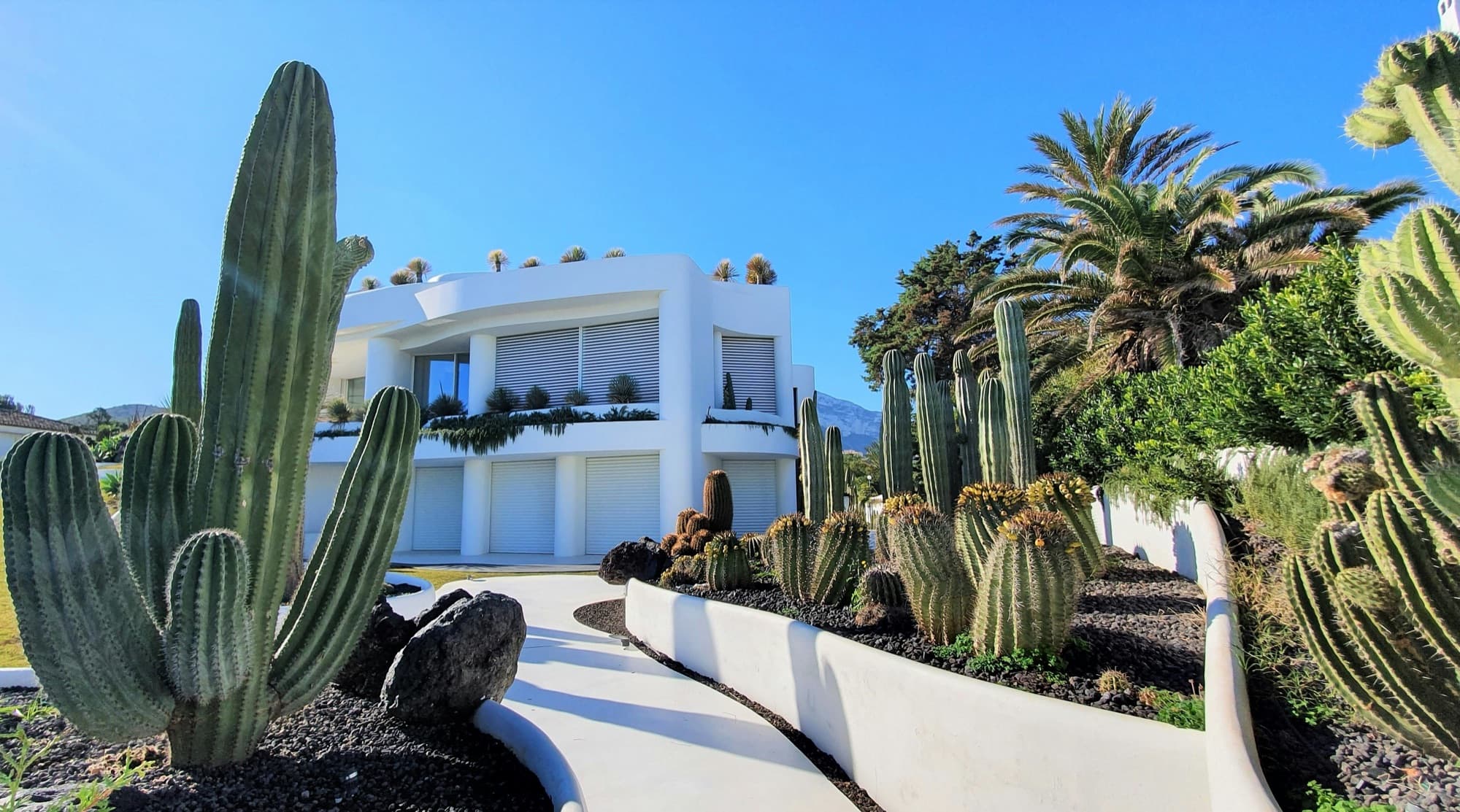
At a viewing you see the property as it is now. The pool that was added ten years ago, the conservatory that turned the terrace into a living room, the garage that is now a guest annexe. What you cannot see is whether anyone ever asked for permission.
This article is about later additions to a property that is otherwise in order. If you have doubts about the property itself, for example a villa on rural land, first read Was that villa in Spain built legally?. It also explains how long a town hall has to take action in each region.
The honest answer has two parts. Yes, extensions and pools without a licence are widespread in Spain, and they appear in sales adverts as a matter of course. At the same time, a discrepancy can be found before you buy, and you can then agree who resolves it and who pays. Afterwards, that is no longer possible.
01Why paper and reality diverge
Paper and reality often diverge with Spanish properties because, for years, owners did not report alterations to the Catastro or the town hall.
The Catastro itself showed how wide that gap is. From 2013 to 2017 it carried out a nationwide regularisation campaign, based on a 2012 law (Ley 16/2012) and using aerial photographs as its source. Owners paid a fee (tasa) of €60 per property plus back IBI (property tax) for the years that were not yet time-barred (Diario Bahía de Cádiz). In the province of Tarragona alone, the Catastro found 57,023 undeclared changes, including 3,992 swimming pools (Diari de Tarragona, January 2018). In Galicia, the figure in 2020 was 7,132 unregistered pools (Xataka).
Two caveats keep this honest. First, these figures relate to declarations for tax purposes, not to licences. A pool that was missing from the Catastro may still have had a licence, and vice versa. Second, because of that campaign, many pools and extensions are now in the Catastro.
That second point is exactly where the trap lies. If a pool is in the Catastro, you pay IBI on it. That says nothing about whether the town hall ever granted a licence for it.
02Three sources that each say something different
There are three official descriptions of a Spanish property: the Land Registry, the Catastro and the town hall's licences. Only the last one tells you whether an extension or pool is allowed.
| Source | What it records | Who maintains it | Does it prove a licence? |
|---|---|---|---|
| Land Registry (nota simple) | Owner, charges, registered buildings and m² | Registro de la Propiedad | No |
| Catastro | Physical description for tax purposes: m², year built, pool | Dirección General del Catastro | No |
| Licences | What the town hall has permitted | Ayuntamiento | Yes, the only one that does |
| Reality | What is actually there | You, with a building surveyor | Not applicable |
In practice, they diverge in a predictable way. The register often lags furthest behind, because an extension only enters the register once the owner has a deed drawn up for it at the notary (declaración de ampliación de obra nueva). The Catastro lags less, partly because of the inspection campaign. And reality is out in front.
The most dangerous combination is an element that does appear in the Catastro but not in the register, and has no licence. On paper it then looks as if everything is in order, because the pool is shown on the cadastral map.
03How to compare them
You find an extension or pool without a licence by checking, element by element, whether it appears in all three sources, and since when it has been there.
- Compare the m². Take the m² from the nota simple, from the Catastro and from the sales advert. An advert sometimes quotes m² that are not registered anywhere. A small difference may come down to measurement; a difference the size of a room points to an extension. How to read the nota simple and which other documents to request is covered in documents before an offer.
- Open the cadastral map. In the Sede Electrónica del Catastro, the consulta descriptiva y gráfica shows the floor plan for each storey. A pool is shown as a separate element.
- Look at old aerial photographs. The historical aerial photographs from the Spanish national geographic institute (IGN) show the year in which the pool or extension appeared. That year determines whether the period within which the town hall can take action has already expired.
- Ask for the licence for each discrepancy. For a pool or extension, that is the building licence (licencia de obras). For minor works, many municipalities require a notification instead (declaración responsable or comunicación previa). No paperwork means no licence, until proven otherwise.
- Count on site. Count bedrooms, bathrooms, covered structures and enclosed terraces, and compare them with the floor plan. A building surveyor will spot more quickly what was added later.
04Who inherits the problem
After the transfer, you as the buyer take over the previous owner's planning obligations, including any obligation to undo an illegal extension or an illegal pool.
This is set out in article 27.1 of the national law on land and urban planning (texto refundido de la Ley de Suelo y Rehabilitación Urbana). Under that provision, a sale does not change the obligations attached to the property, and the new owner takes the place of the old one. The Tribunal Supremo also applies this to demolition orders: the town hall can pursue the new owner. Whatever happens between buyer and seller is a separate matter (elderecho.com).
In practice, this means the following. A fine for the offence itself stays with whoever committed it. But restoring the situation, and the costs that come with it, falls to you after the transfer. You can take action against the seller afterwards, but that is a civil case you would rather avoid.
Something similar applies to tax. If the Catastro discovers an extension or pool after your purchase, it adjusts the value and issues a back-assessment of IBI for the years that are not yet time-barred: up to 4 years back (Diari de Tarragona). Through the property, that back-assessment can end up with you, even for the period of the previous owner.
05What regularisation costs
Regularising an extension or pool involves four cost items: legalisation at the town hall, the deed at the notary, the tax on that deed and the update in the Catastro. This only works if the element conforms to the zoning plan; otherwise legalisation is not possible.
| Item | What it is | Amount |
|---|---|---|
| Legalisation at the town hall | Application for a retrospective licence (licencia de legalización), with a project by an architect | Municipal fees plus the ICIO construction tax, which is at most 4% of the construction costs (art. 102 Ley de Haciendas Locales); the architect's fee |
| Deed at the notary | Declaración de ampliación de obra nueva, followed by entry in the register | Notary and registry costs |
| Tax on the deed (AJD) | Tax on the value of the construction | Andalusia 1.2%, Comunitat Valenciana 1.4% (since 1 June 2026), Catalonia 1.5% (guiafiscal.es) |
| Catastro | Adjustment of the cadastral value | Higher IBI from then on, plus any back-assessment for up to 4 years |
We deliberately do not give a total figure. It depends on the scale of the work, the municipality and whether a fine is added. These costs come on top of the usual buying costs, so ask an architect for an estimate before you agree the price.
If the element does not conform to the zoning plan, everything depends on its age. If the period within which the town hall can take action has expired, the element is tolerated but not legal. If the period is still running, demolition is possible. How those periods work in each region is covered in our article on legally built villas.
06How to factor it into your offer
If you find an extension or pool without a licence before you buy, set out in the arras contract (the deposit contract) who resolves it, who pays and what happens if it cannot be done.
The seller regularises before the notary. This is the cleanest route. The seller applies for legalisation, has the deed drawn up and updates the Catastro. Set out in the arras contract that the transfer only takes place once all of that is done, with a deadline, and that otherwise you get your deposit back.
You offset it against the price. If the seller does not want to wait, you can sort it out yourself after the purchase. In that case, first have an architect confirm that legalisation is possible and what it will cost. That estimate belongs in your offer, not in a conversation afterwards.
You walk away from the purchase. If the element does not conform to the zoning plan and the period is still running, you are buying a potential demolition order. That is not a risk you can price in.
Whichever route you choose, have the arras contract describe precisely which buildings, extensions and pool are included in the sale, along with their status. Then there can be no dispute later about what the seller knew.
Frequently asked questions
Does a swimming pool in Spain need a licence?
A built-in pool is a construction for which the town hall requires a licence or a notification. Which of the two depends on the municipality.
If a pool is in the Catastro, is it legal?
No. The Catastro keeps records for tax purposes; only the town hall grants licences. So always ask for the licence itself.
Who pays for the legalisation?
That is negotiable and belongs in the arras contract. Without an agreement, you bear the consequences after the transfer.
Can I have a pool or extension built myself after the purchase?
Yes, with a licence from the town hall obtained in advance. On rural land and for a property with tolerated status, extensions are restricted, so have that checked before you buy. If the property is close to the sea, the rules of the Ley de Costas also apply; see buying a house near the sea.
This is one of the points we check on every purchase. Everything else that is involved is covered in the guide Buying a home in Spain. Would you like to extend or put in a pool yourself after the purchase? The licensing process is part of our renovation support. Book a no-obligation conversation and we will compare the paperwork for the property you have in mind with what is actually there.
Sources
- Iberley: art. 18 Ley del Catastro (declaration before the notary)
- elderecho.com: art. 27 TRLSRU and demolition orders against a new owner
- guiafiscal.es: AJD by region in 2026
- Cuatrecasas: AJD in the Comunitat Valenciana to 1.4% from 1 June 2026
- Diario Bahía de Cádiz: Catastro regularisation campaign, €60 tasa and back IBI
- Diari de Tarragona: 3,992 undeclared pools in Tarragona (2018)
- Diari de Tarragona: IBI back-assessment for up to 4 years (2018)
- Xataka: 7,132 unregistered pools in Galicia (2020)
- Sede Electrónica del Catastro

Thijs Kranenborg
Thijs Kranenborg, Valencia consultant and co-founder. Thijs guides buyers from abroad on the Costa de Valencia and the Costa Blanca. At a viewing he compares the floor plan with what is actually there, before a buyer makes an offer.