

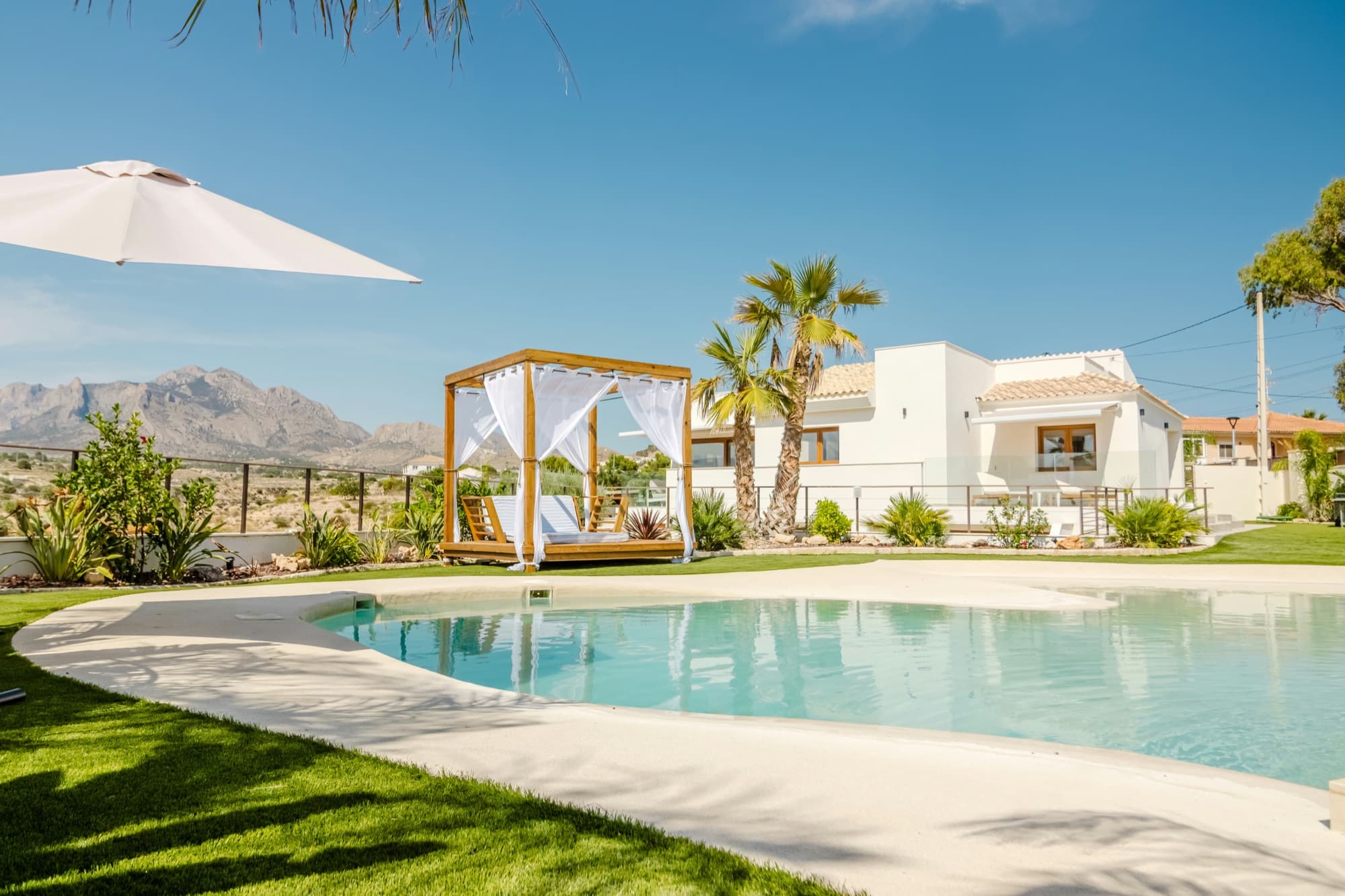
Anyone viewing a villa in the countryside sooner or later arrives at the same question: was this house actually built entirely legally? It is a fair question. In parts of Spain, homes were built for decades on land where building was not allowed, and those homes are now on the market alongside everything else.
First, the basics. In Spain, the zoning of the land determines what may be built on it. On suelo urbano (urban land) and in approved urbanisations, building is the intended use. On suelo rústico or suelo no urbanizable (rural land where, in principle, no building takes place), a home is only permitted under strict conditions. That is where the vast majority of illegal building is found.
The honest answer has two parts. Yes, there are hundreds of thousands of homes in Spain that were not built according to the rules. At the same time, a home that is too old to be demolished is not necessarily a bad purchase, as long as you know what its status does and does not allow. The risk depends on the location and can be checked in advance, just like flood risk.
01How common it is
Illegally built homes are far from a fringe issue in Spain: the regional governments of Andalusia and Valencia each put their number in the hundreds of thousands.
In Andalusia, the Junta estimated in 2019 that there were more than 300,000 illegally built homes, around 45,000 of them in the province of Cádiz (Diario Bahía de Cádiz). In the Comunitat Valenciana, when the law was amended in 2019, the Generalitat cited around 350,000 homes built without a licence on non-buildable land (AlicantePlaza).
Two caveats keep this honest. First, these are estimates from inspection services, not counts, and they are several years old. Both regions have since introduced rules to regularise some of these homes. Second, they are largely detached villas and small clusters of houses on rural land, not apartments in an approved development.
For you as a buyer, this means the following. With an apartment or townhouse in an existing urbanisation, the main question is whether anything was added later, such as an enclosed terrace. With a detached villa or finca in the countryside, it is about the home itself, and checking in advance is essential.
02Legal, tolerated or illegal: three situations
In planning terms, every Spanish home falls into one of three situations. Each one determines something different: what you may do with the home, what the town hall can still do and what the home is worth.
Built legally. The home has a building licence (licencia de obras) and was built in accordance with it. It also has a certificate of habitability: a licencia de primera ocupación, or in some regions a cédula de habitabilidad. You can renovate within the rules, the home is connected to the utilities, and renting it out is possible if the local rules allow it.
Illegal and still enforceable. The home was built without a licence, or differently from what was licensed, and the period within which the town hall can take action is still running. The town hall can then open proceedings. These end in legalisation if the home fits within the zoning plan, and otherwise in demolition. This is the situation you want to rule out as a buyer.
Too old to be demolished. Once that period has expired, the town hall can no longer demolish. That does not make the home legal; it makes it tolerated. In Andalusia, such a home can be granted the status asimilado a fuera de ordenación (AFO) on application. Under the 2019 rules, a home could not be connected to basic utilities before that decision, and no building work could be carried out on it (derecholocal.es). In Valencia, too, the expiry of the period does not legalise the home. As long as the breach of the rules persists, renovation, extension or structural reinforcement is not permitted (administracionpublica.com).
Registration in the Land Registry is not a licence
For buyers, this is the most important detail in this article. A home can be entered in the Land Registry without ever having been licensed. Article 28.4 of the national law on land and urban planning (texto refundido de la Ley de Suelo y Rehabilitación Urbana) makes it possible to register an old building with nothing more than proof of its age. This becomes possible as soon as the period for demolition has expired. The registrar (registrador) then notifies the town hall of the registration. So the villa appears neatly on the nota simple, while there is no licence behind it.
03How long the town hall can take action, by region
How long a town hall can take action against illegal building varies by region: 6 years after completion in Andalusia and Catalonia, 15 years in Valencia. On protected land there is no time limit anywhere.
| Region | Period for taking action | What applies afterwards | Law |
|---|---|---|---|
| Andalusia (Costa del Sol) | 6 years after full completion | No more demolition; AFO status on application, with limited rights | LISTA (Ley 7/2021), art. 153 (COA Málaga) |
| Comunitat Valenciana (Costa Blanca, Costa de Valencia) | 15 years after full completion | Not legalised; no renovation or extension while the breach persists; regularisation possible through minimización de impacto territorial | TRLOTUP (Decreto Legislativo 1/2021) |
| Catalonia (Costa Brava, Costa Dorada) | 6 years | No further restoration measures | Decreto Legislativo 1/2010 (Normatia) |
The time limit is less straightforward than the table suggests. Three points make the difference.
Protected land is never time-barred. On land with protected status, in green zones and on public land such as the coastal strip and riverbanks, the authorities can always take action. In Andalusia, these exceptions are set out in article 153.2 of the LISTA. Registration via article 28.4 is not possible there either, as the Spanish registry authority confirmed in 2026 for a home in a river zone (BOE). In Valencia, some lawyers read the 2019 amendment as meaning that ordinary non-buildable land no longer has a time limit either (administracionpublica.com). Always have this point assessed for your home.
The clock only starts at full completion. If you want to show that the period has expired, you need evidence of when the home was finished. That evidence can be a year of construction in the Catastro, a certificate from an architect or an old aerial photograph. An extension or swimming pool added later generally has its own period, which only starts once that work is finished.
Risk-prone land counts too. Under the Andalusian rules of 2019, AFO status was ruled out for homes on land with flood or erosion risk, among other things (PwC). The check from our flood risk blog is therefore doubly useful for an older villa.
04How to check it yourself
You check whether a villa is legal by comparing four sources: the Land Registry, the Catastro, the licences and the home itself.
- Request the nota simple. This is an extract from the Land Registry (Registro de la Propiedad). You can get it from the seller or yourself through the Registradores website. Check which buildings and how many m² are registered. Also look for entries about fuera de ordenación or ongoing proceedings. Which other documents to request before making an offer is covered in documents before an offer.
- Look up the home in the Catastro. Through the Sede Electrónica del Catastro you can see the year of construction, the built m², whether a swimming pool is registered and how the land is classified. If there is a house on land classified as rústico, that is the first signal to look more closely.
- Request the licences. These are the building licence and the certificate of habitability. If they are missing, ask for the AFO decision (Andalusia) or a certificate of age from an architect.
- Have the town hall confirm the status. A certificado urbanístico, also known as información urbanística, states the zoning of the land. Also have your lawyer check whether enforcement proceedings are under way (expediente de disciplina urbanística).
- Compare with what you see. Count the buildings, the swimming pool and the extensions, and check them against the paperwork. Historical aerial photographs from the Spanish geographic institute (IGN) show when something was added. What else to check during a viewing is in our viewing checklist.
| Document | What it tells you | What it does not prove |
|---|---|---|
| Nota simple | Owner, registered buildings, mortgages, entries | That the home is licensed |
| Catastro | Year of construction, m², land classification | Ownership or legality |
| Building licence and certificate of habitability | That the home was licensed and declared habitable | That later extensions are licensed too |
| AFO decision | That the town hall can no longer demolish | That the home is legal |
| Certificado urbanístico | Zoning of the land | Whether proceedings are under way (ask about this separately) |
05What to do if it does not add up
If a villa's legal status does not add up, you have three options. The seller can resolve it before the signing at the notary, you can adjust the price and the contract, or you can walk away from the purchase.
The seller has it legalised before completion. If the home or the extension fits within the zoning plan, the seller can apply for legalisation. Stipulate in the arras contract that completion only takes place once the legalisation has been finalised, and that otherwise you get your deposit back. In Valencia, homes on non-buildable land have their own route: the minimización de impacto territorial. The owner carries out works to limit the impact on the surroundings, such as a connection to the sewer network, after which regularisation is possible (DOGV).
You adjust the price and your plans. If the period has expired and the home has AFO status or a comparable status, you are buying a tolerated home. Those restrictions belong in the price. They also determine what you can do later: if you want to extend or carry out a major renovation, have that assessed before you buy.
You walk away from the purchase. If the period is still running, the home is on protected land or proceedings are under way, you would be buying a risk that no price reduction can cover. In that situation, we advise buyers not to go ahead.
Frequently asked questions
Does a villa automatically become legal after 6 or 15 years?
No. After that period the town hall can no longer demolish, but the home is still in breach of the rules. As a result, renovating or extending is restricted.
Can I get a mortgage on a home with AFO status?
Sometimes, but there is no fixed rule. The bank's valuer is required to check whether the home fits within the current zoning plan (Orden ECO/805/2003), so AFO status can lower both the valuation and the bank's willingness to lend (Arquitasa). Check with your bank before you make an offer, and give the AFO decision to the valuer straight away.
Can I let an AFO home to holidaymakers?
In Andalusia, in principle not: the rules on tourist rentals exclude homes with AFO status, unless the town hall expressly gives permission in advance (art. 1.3.d Decreto 28/2016, Junta de Andalucía). What else applies by region and by development is covered in Holiday rentals in Spain: can this home be rented out?.
Does this also apply to new builds?
With a new build from a developer, you check the building licence before you pay your first deposit. The problem of tolerated construction mainly arises with existing villas on rural land.
This is one of the points we check during a purchase. What else is involved is set out in the guide Buying a home in Spain. Have you got your eye on a villa on the Costa del Sol or the Costa Blanca? Book a no-obligation conversation and, together with our lawyer, we will check the paperwork against the home.
Sources
- COA Málaga: summary of planning enforcement under the LISTA (2026)
- BOE: decision on registration via art. 28.4 in a river zone (July 2026)
- DOGV: minimización de impacto territorial, Comunitat Valenciana (2022)
- Normatia: enforcement under the Catalan planning law
- PwC: Andalusian Decreto-ley 3/2019 on irregular homes
- derecholocal.es: rules before and after the AFO decision
- Junta de Andalucía: Decreto 28/2016 on tourist homes, consolidated with Decreto 31/2024 (art. 1.3.d, AFO)
- administracionpublica.com: the 15-year time limit in Valencia
- administracionpublica.com: time limits on non-buildable land in Valencia
- Arquitasa: mortgages on a home fuera de ordenación
- Diario Bahía de Cádiz: estimate of 300,000 homes in Andalusia (2019)
- AlicantePlaza: estimate of 350,000 homes in Valencia (2019)

Thijs Kranenborg
Thijs Kranenborg, Valencia consultant and co-founder. Thijs guides buyers from abroad on the Costa de Valencia and the Costa Blanca. For a villa on rural land, he compares the nota simple, the Catastro and the licences side by side before a buyer makes an offer.