

After the summers of 2025 and 2026, wildfires are a legitimate concern for many buyers. Images of plumes of smoke and evacuated villages were everywhere. The largest fires raged inland and in the north-west, but the coast has not been spared either.
In September 2021, fire swept through Sierra Bermeja, in the hills behind Estepona and Benahavís. It affected 8,401 hectares across seven municipalities (Junta de Andalucía). Almost 3,000 people had to leave, including residents of the Forest Hill, Abejeras and Montemayor urbanisations (residential estates) (Deia). In August 2022, more than 12,000 hectares burned in the Vall d'Ebo, inland in the Marina Alta, and over 1,500 people were evacuated (Última Hora).
The honest answer has two parts. Yes, a wildfire can reach homes on the Costa del Sol and the Costa Blanca too. At the same time, just as with flood risk, this is not a matter of luck. The risk sits in a recognisable place, you can assess it for each property, and much of it can be reduced.
01How big the risk is
In 2025 Spain had its worst fire year since European records began in 2006, and 2026 has been a severe year too.
According to EFFIS, the European forest fire information system, more than 400,000 hectares burned in Spain in 2025, a national record in the European series (AFP via Observador). For 2026, the Spanish Ministry for the Ecological Transition put the total up to 23 August at an estimated 259,649 hectares, with 44 large fires of more than 500 hectares (MITECO).
Two caveats keep this honest. The first is that the vast majority of those hectares burn in a handful of large fires in sparsely populated inland areas. Between 6 and 19 August 2025, 322,299 hectares burned, more than 80% of the total for the whole year (El Debate). The second is that these figures refer to hectares of forest and scrubland, not to homes. They do not include a national count of houses lost to fire.
So for you as a buyer, what matters is not the national figure but how close your home is to continuous forest. That is what the rest of this article is about.
02Where the risk lies
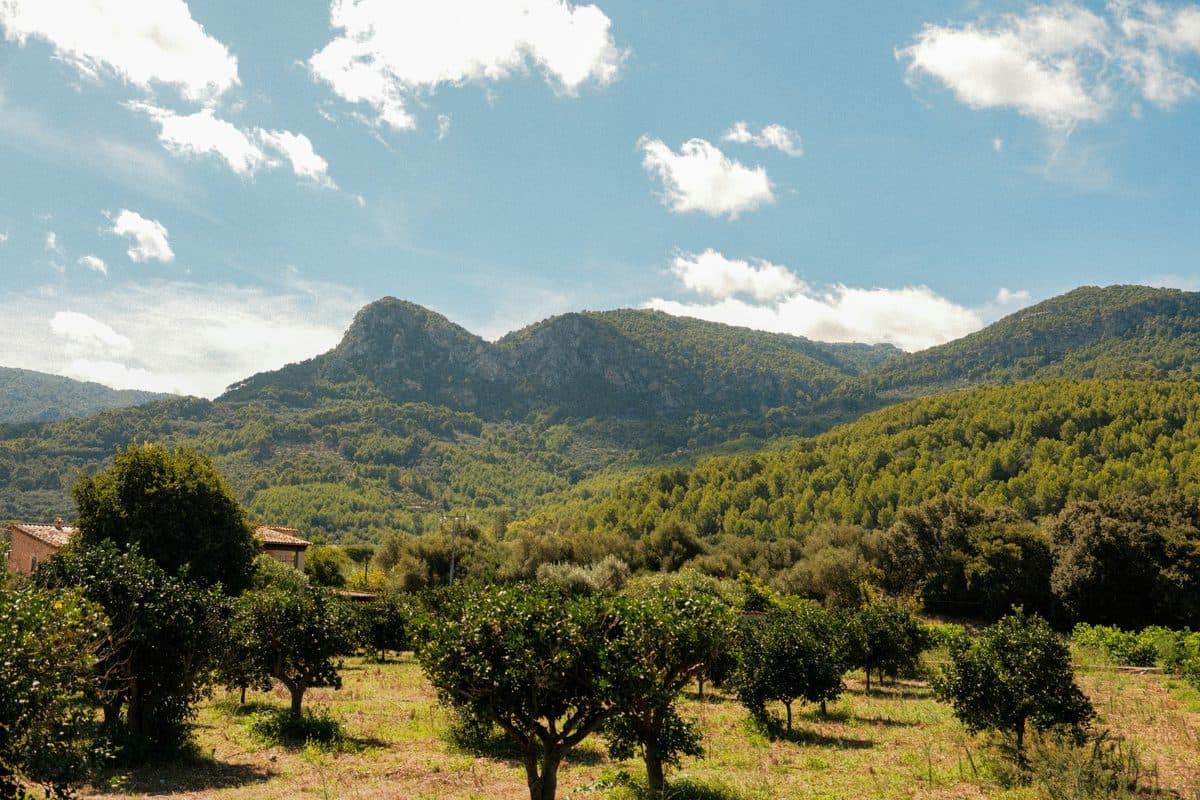
The fire risk to a home lies in the interfaz urbano-forestal: the zone where buildings and forest meet.
The Spanish government set out this concept in 2013 in the national guideline for wildfire emergency plans (Real Decreto 893/2013). It also states that urbanisations in this zone need a self-protection plan (plan de autoprotección). The idea is simple: where houses stand among the trees or right up against them, a wildfire also becomes a house fire.
Whether a home lies within that zone depends on its distance from the forest. In Andalusia, the fire regulations apply in a 400-metre strip around forest land, the zona de influencia forestal. In Catalonia it is 500 metres. An apartment in a village centre or on the seafront is usually outside it; a villa on a wooded hill is often inside.
Within that zone, the risk varies from one home to the next. The factors that matter most:
- Distance to continuous forest. A home in the middle of the forest carries a different risk from one on the edge of a compact urbanisation.
- Slope. Fire travels faster uphill. A home above a wooded slope takes more heat than one below it.
- Access. A single road in and out means evacuation and the fire service share the same route.
- Maintenance. A firebreak around the urbanisation and cleared empty plots slow a fire down; neglected plots do the opposite.
On paper, all of this is regulated. In practice, the vast majority of urbanisations in forest areas have no self-protection plan, the Spanish professional association of forestry engineers has warned (Ecoticias). Whether your urbanisation has one is therefore something you ask, not something you assume.
03How to check it yourself
You assess a home's fire risk by looking at its location, looking up previous fires and asking the town hall and the community of owners (comunidad de propietarios) what arrangements are in place.
- Look at the property on a satellite map. How far is it to continuous forest? Is the home above or below a wooded slope? How many roads lead into and out of the urbanisation?
- Look up previous fires. The EFFIS map viewer shows the burnt areas of fires from roughly 30 hectares upwards, including those from previous years. A fire nearby tells you something about the terrain, and about what will not be built there in the decades to come (see the section on insurance and the land).
- Ask the town hall whether the property is in the fire zone. In Andalusia that is the zona de influencia forestal; in Catalonia it is the plànol de delimitació (delimitation map) that every municipality with forest draws up. Also ask whether the urbanisation has an approved self-protection plan.
- Ask the community of owners about the firebreak. Who creates the strip around the urbanisation, who maintains it and what does it cost each year? Are there letters from the town hall asking for maintenance work?
- Look around you during the viewing. Watch out for pines against the façade, dead branches and dry shrubs on the plot, wooden pergolas and woodpiles against the house, and the distance to the nearest fire hydrant.
04By region: what is expected of owners
If you buy a home in the fire zone, obligations come with it. They differ by region, but everywhere they come down to the same thing: keep the area around your home clear of flammable material and contribute to the firebreak around your urbanisation.
| Region | Where the rules apply | What owners do | Law |
|---|---|---|---|
| Andalusia (Costa del Sol) | Forest plus a 400 m strip around it (zona de influencia forestal) | Keep a 15 m strip around homes clear of dry vegetation; urbanisations have a self-protection plan; since 2026, owners of forest land must show with a certificate every 5 years that the prevention work has been carried out | Ley 5/1999, Decreto 371/2010 (Plan INFOCA), Ley 3/2026 de Montes de Andalucía |
| Comunitat Valenciana (Costa Blanca, Costa de Valencia) | Urbanisations in or bordering forest land | A firebreak between buildings and forest, in practice 25 to 30 m wide depending on the slope, created and maintained by the owners; a self-protection plan | PATFOR (Decreto 58/2013), TRLOTUP annex XI, Plan Especial frente al Riesgo de Incendios Forestales |
| Catalonia (Costa Brava, Costa Dorada) | Buildings in forest or within 500 m of it | A strip of at least 25 m around the urbanisation at the owners' expense; plots within the urbanisation kept clear; if the urbanisation does nothing, the town hall carries out the work and recovers the costs | Llei 5/2003 (amended in 2014) |
Sources: forestales.net, Iberley, TRLOTUP annex XI, Diputació de València, El Español on Ley 3/2026, BOE, Llei 5/2003.
The Catalan rules are the clearest about who pays. They were introduced after a fire near Lloret de Mar in 1979 in which 21 residents of an urbanisation died (Sostenible.cat). In Andalusia, the new forestry law of 2026 shifted responsibility more explicitly onto owners of forest land. If a villa comes with a piece of forest, ask which obligations apply to it under that law; not every small landowner has the same formal obligations.
05Insurance and what a fire does to the land
Wildfire damage is covered by your own home insurance, not by the Consorcio de Compensación de Seguros. That is the big difference from flooding.
The Consorcio only pays out for a fixed list of extraordinary risks: floods, earthquakes and tsunamis, volcanic eruptions and storms with gusts above 120 km/h. A wildfire is not on that list, however large it is, and not even when a state of emergency is declared (Roams). Fire is, however, part of the basic cover in most Spanish home insurance policies (seguro de hogar), even when the fire comes from outside (OCU). If you have a mortgage, fire insurance is compulsory (Legálitas).
The practical lesson: check the policy on two points. Is fire coming from outside covered, and is the home insured for its rebuild cost rather than its purchase price? For a home in the fire zone, that is no mere formality.
What happens to the land after a fire
In Spain, burnt forest land cannot be given a different use for at least 30 years. That is laid down in article 50 of the national forestry law (Ley de Montes). An exception is only possible if the new use was already included in an approved plan before the fire, or if a law allows it for overriding reasons of public interest (Iberley).
For you, that means a burnt hillside next to your home will not become building land. The view changes for a while, but no new urbanisation will appear where the forest used to be.
06What you can do yourself as an owner
It is no coincidence that the rules focus on the first few metres around the house. That is where you as an owner have influence, even if you are away for much of the year.
- Keep the strip around the house clear. In Andalusia that means 15 metres free of dry vegetation and dead wood. Cut back branches from the façade and the roof.
- Move flammable material away from the façade. Woodpiles, stored furniture and dry planters do not belong against the house.
- Keep the roof and gutters clean. Pine needles and leaves in the gutter catch flying embers.
- Arrange maintenance for when you are away. For a second home, a gardener or property manager who clears the garden before the summer is the most important measure of all.
- Know your urbanisation's plan. Know the evacuation route and where the assembly point is. If there is no plan, ask the community of owners to draw one up.
- Respect the burning bans. In summer, strict rules apply in fire zones to fires, barbecues and tools that give off sparks. A fine is the least of your problems if things go wrong.
Frequently asked questions
Does the Consorcio pay for wildfire damage?
No. Wildfire is not on the Consorcio's list of extraordinary risks. The damage is covered by your own home insurance.
Can the burnt land next to my house be built on after a fire?
No, not for at least 30 years, unless the development was already included in an approved plan before the fire. That is governed by article 50 of the Ley de Montes.
Who pays for the firebreak around an urbanisation?
The owners, usually through the community of owners or the urbanisation's management body. Ask before you buy what it costs each year.
Is an apartment by the sea also at risk?
If it lies outside the fire zone of 400 to 500 metres around forest, it falls outside the wildfire prevention rules. The risk lies mainly with homes in or bordering forest land.
The fire check is one step in a longer purchase; you will find the rest in our guide Buying a home in Spain. Considering a villa in the hills on the Costa del Sol or the Costa Blanca North? Book a no-obligation conversation and we will look at the location, the urbanisation and the insurance together.
Sources
- MITECO: wildfire progress report, 1 January to 23 August 2026
- EFFIS: European forest fire information system, map viewer
- AFP via Observador: record area burned in 2025
- El Debate: breakdown of the hectares burned in 2025
- Junta de Andalucía: Sierra Bermeja fire, 2021
- Deia: Sierra Bermeja evacuations, 2021
- Última Hora: Vall d'Ebo fire, 2022
- BOE: Llei 5/2003, Catalonia
- Iberley: TRLOTUP annex XI, fire prevention in Valencia
- El Español: Ley 3/2026 de Montes de Andalucía
- Iberley: art. 50 Ley de Montes
- Roams: what the Consorcio does and does not cover
- OCU: insurance and natural disasters
- Ecoticias: urbanisations without a self-protection plan

Thijs Kranenborg
Thijs Kranenborg, Valencia consultant and co-founder. Thijs guides buyers from abroad on the Costa de Valencia and the Costa Blanca. For a villa in the hills, he looks at the distance to the forest, the access roads and the arrangements for the firebreak before a buyer makes an offer.